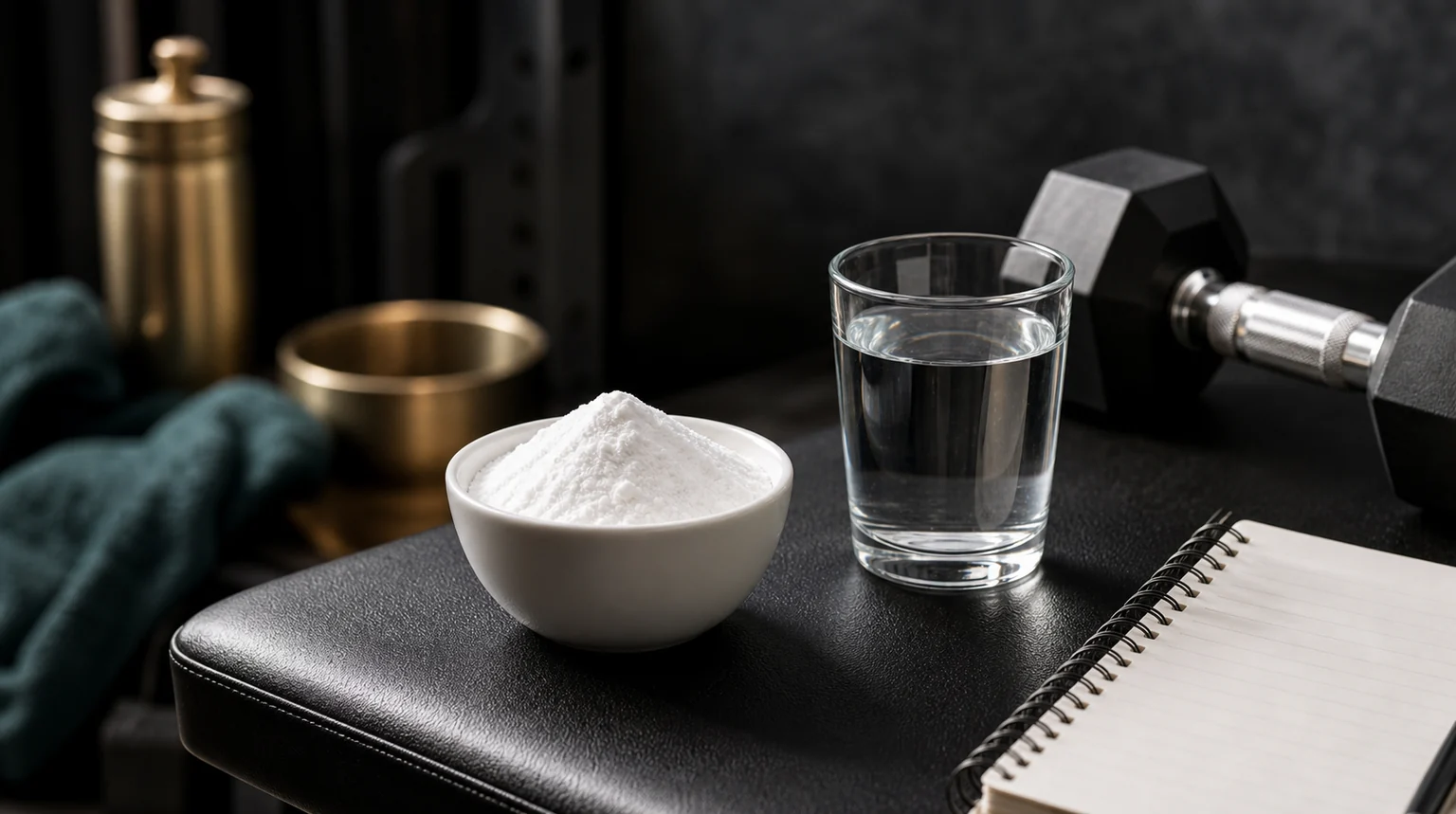
Quick answer: sodium bicarbonate may help short, hard efforts, but stomach symptoms are a major trade-off.
Sodium bicarbonate, often called baking soda, can provide a modest performance benefit during some short, high-intensity or repeated-effort activities. That does not make it a general muscle-building supplement or a sensible default for every lifter. A systematic review published on July 24, 2026 summarized 101 investigations and found that gastrointestinal symptoms were common across the literature. The authors also found that the proposed ways to reduce those symptoms have not been compared well enough to rank.
- Best fit: an experienced athlete who has a specific performance reason to consider it and access to qualified nutrition or medical guidance.
- Use caution: anyone with a sodium restriction, high blood pressure, heart or kidney disease, fluid-balance concerns, pregnancy, medication questions, or a history of severe gastrointestinal symptoms.
- Practical takeaway: build training, food, sleep, and hydration habits first. Do not try a new supplement for the first time before a competition, hard session, or travel day.
Read the full 2026 systematic review in PubMed Central and its PubMed record. This guide intentionally does not provide a dose, schedule, stacking plan, or symptom-workaround protocol.
Who this guide is for—and who should be cautious
This is an evidence explainer for lifters who have seen sodium bicarbonate discussed as a performance aid. It can help you decide whether the question deserves a conversation with a qualified sports dietitian, physician, or pharmacist. It is not a personal supplement plan.
Most recreational lifters can make meaningful progress without adding sodium bicarbonate. If your goal is muscle gain, the larger levers are a repeatable resistance-training plan, enough food and protein, adequate sleep, and gradual progression. If your goal is strength, practice with the lifts and manage fatigue before looking for a short-lived performance edge.
Extra caution is appropriate if a clinician has asked you to limit sodium or if you have high blood pressure, heart failure, kidney disease, swelling, fluid-balance problems, or a condition affected by electrolyte changes. MedlinePlus explains why sodium limits can matter for people with high blood pressure or heart failure and why medication questions belong with a healthcare professional. A performance supplement should not be treated as separate from your medical history.
What sodium bicarbonate is supposed to do
Hard efforts increase the concentration of hydrogen ions in working muscle. Sodium bicarbonate is an alkaline compound that can increase the body's available buffering capacity, which is one reason researchers have studied it for intense efforts that produce a lot of metabolic stress. The National Institutes of Health Office of Dietary Supplements describes a possible small-to-moderate benefit for short-term, intermittent high-intensity activity, especially in trained athletes, while also listing nausea, stomach pain, diarrhea, and vomiting as reported adverse effects.
That mechanism does not mean a lifter will automatically lift more weight, complete more repetitions, or build more muscle. The research is usually about a narrow performance task under controlled conditions. A result in a repeated sprint, hard interval, or short repeated-effort setting cannot be converted into a promise about your squat, deadlift, hypertrophy block, or physique.
It is also different from creatine and protein powder. Creatine is used as a daily training supplement with a different evidence base and purpose. Protein powder is a convenient food option when protein intake is otherwise difficult. Sodium bicarbonate is better understood as a context-specific performance aid with a meaningful tolerability and sodium trade-off.
What the July 24, 2026 review found
The 2026 systematic review by Winter, Sarac, Wilson, and colleagues examined research on gastrointestinal symptoms associated with sodium bicarbonate supplementation. The search covered literature from February 2024 through March 2026, and the authors summarized 101 investigations in six groups: single-intake approaches, spread-intake approaches, multi-day approaches, acute-versus-chronic comparisons, delivery forms, and other designs.
The central finding is not that every person will become ill. It is that stomach and intestinal symptoms are common enough to be the main practical limitation. Across the research, symptom severity varied from mild to severe, and symptoms appeared more likely when a larger amount was taken at once. That is a population-level pattern, not a way to predict exactly what will happen to one lifter.
The review also limits how confidently anyone should present a “best way” to use the supplement. Some studies explored spreading intake, special delivery forms, or taking it with food. Direct comparisons between these approaches were absent or limited, symptom reporting varied widely, and 26 of the 101 investigations did not perform inferential analysis of the symptom differences. The authors therefore did not rank a universally effective method for avoiding gastrointestinal problems.
This matters because online advice often turns a research option into a simple recipe. The paper does not justify telling every lifter to use sodium bicarbonate, and it does not show that a delivery trick removes the underlying uncertainty.
What it may help—and what it cannot establish
The most defensible use case is narrow: an already well-trained person with a short, intense, repeated-effort demand who wants to discuss whether a possible performance benefit is worth the downsides. Even there, the likely benefit should be treated as an experiment with uncertain individual response, not as a required part of serious training.
- It may help: some short, high-intensity or repeated-effort performances in trained people.
- It cannot establish: direct muscle growth, a permanent strength increase, better recovery, or a safer workout.
- It cannot establish: that you personally will tolerate it, that a product label is accurate, or that a convenient delivery format removes all risk.
- It cannot replace: sound programming, food intake, sleep, hydration, technique, or medical care.
For a bodybuilding reader, this distinction prevents a common category error. A supplement can change how a narrow session feels or performs without improving the underlying adaptation that comes from months of consistent training. If the supplement causes diarrhea, cramps, nausea, or disrupted sleep, the total training week may become worse even if one session looks better on paper.
Safety questions to answer before considering it
How much sodium would this add to your day? Sodium bicarbonate is not a sodium-free performance powder. The total sodium context includes food, drinks, medications, antacids, and other products. If you already follow a sodium-restricted plan, do not treat the supplement as a minor detail. Ask the clinician who set the restriction whether it is appropriate.
Could your health history change the decision? High blood pressure, heart failure, kidney disease, swelling, electrolyte problems, pregnancy, and some medicines can make self-directed electrolyte changes a poor choice. The right response is not to diagnose yourself from an article. Bring the exact product label and your full supplement list to a qualified clinician or pharmacist.
What would make you stop? Mild stomach discomfort is not a badge of commitment. Stop and seek timely medical advice for persistent vomiting or diarrhea, severe abdominal pain, marked weakness, confusion, fainting, chest pain, breathing trouble, severe headache, or unusual swelling. Urgent symptoms should not be managed by changing a workout or taking another supplement.
Does product quality matter? Yes. The U.S. Anti-Doping Agency explains that dietary supplements are regulated after they reach the market and that contamination or inaccurate labels can create health and sport-eligibility risks. Third-party certification can reduce some contamination risk, but it does not prove that a product is useful for you, free of every concern, or appropriate with your medical history.
A conservative decision process for lifters
- Name the exact goal. Is the goal a short repeated-effort event, a normal hypertrophy session, a one-rep max, or simply better energy? If the goal is vague, a performance supplement is probably not the first lever to pull.
- Audit the basics. Look at recent training consistency, meals, protein, carbohydrate availability, hydration, sleep, and rest between hard sessions. Fix a clear basic problem before adding a supplement with known gastrointestinal downsides.
- Review your health context. Check sodium limits, blood-pressure history, kidney or heart conditions, pregnancy, digestive conditions, and medicines with a clinician or pharmacist. Do not rely on a store employee or an internet comment for this step.
- Read the current evidence. The 2026 review is more useful than a confident anecdote because it shows both the possible performance rationale and the uncertainty around symptom reduction.
- Protect important sessions. Never make a new supplement trial part of a competition, max-out day, long drive, or event where vomiting or diarrhea would create an avoidable problem.
- Keep the decision reversible. If the risk, cost, or stomach burden is not clearly worth the possible benefit, leaving it out is a reasonable performance decision.
Common mistakes
- Copying a protocol from a different sport: a study condition is not automatically a bodybuilding recommendation.
- Confusing a performance signal with muscle growth: more work in one session does not prove more hypertrophy over a training block.
- Ignoring total sodium: the supplement still counts even when the rest of the diet looks “clean.”
- Assuming a special delivery format is a guarantee: the 2026 review did not establish a universally reliable way to prevent gastrointestinal symptoms.
- Using it to push through warning signs: chest pain, fainting, severe breathing trouble, unusual swelling, confusion, severe weakness, or serious abdominal symptoms need medical attention, not a harder session.
- Stacking several new products at once: if a problem appears, you will not know which product, ingredient, or interaction caused it.
Frequently asked questions
Does sodium bicarbonate build muscle?
No direct conclusion supports that claim. It may affect performance in certain short, intense tasks, but muscle gain still depends on training stimulus, recovery, food intake, and time. A better session on one day is not the same as a larger long-term training response.
Is baking soda the same as sodium bicarbonate?
They refer to the same chemical compound, but that does not mean every household product is suitable for personal use or that a product is appropriate with your health history. Product labels, added ingredients, and medical context matter.
Can I use it instead of creatine?
No. They have different purposes and evidence bases. Sodium bicarbonate is a context-specific buffering aid; creatine is a different supplement used in a broader range of resistance-training contexts. Neither should be used to avoid fixing a weak training, food, or recovery plan.
Should I try it before my next workout?
Do not make a new supplement trial part of an important session. If you are considering it at all, discuss the product and your health context with a qualified professional first. This guide does not provide a dose or timing plan.
Sources and further reading
- Winter IP, Sarac P, Wilson PB, et al. Gastrointestinal Symptoms Associated With Sodium Bicarbonate Supplementation Protocols: A Systematic Review. European Journal of Sport Science. July 24, 2026.
- PubMed record for PMID 42499192.
- NIH Office of Dietary Supplements: Dietary Supplements for Exercise and Athletic Performance.
- U.S. Anti-Doping Agency: Supplement Connect.
- MedlinePlus: Low-salt diet.
Related reading: compare common bodybuilding supplements and safety questions, plan protein across the day, use RPE to manage training effort, and adjust training after poor sleep.