The four levers that matter most
Maintaining muscle in a calorie deficit is a risk-management problem, not a promise. The four main levers are the size of the deficit, the resistance-training stimulus, protein intake, and recovery. A plan becomes harder to recover from when several stressors rise together—for example, fewer calories, more cardio, more lifting volume, and less sleep in the same week.
- Deficit: the food reduction must be large enough to produce a trend, but not so aggressive that training quality and daily function keep deteriorating.
- Resistance training: keep meaningful work for the major movement patterns so the body continues to receive a reason to retain strength and muscle.
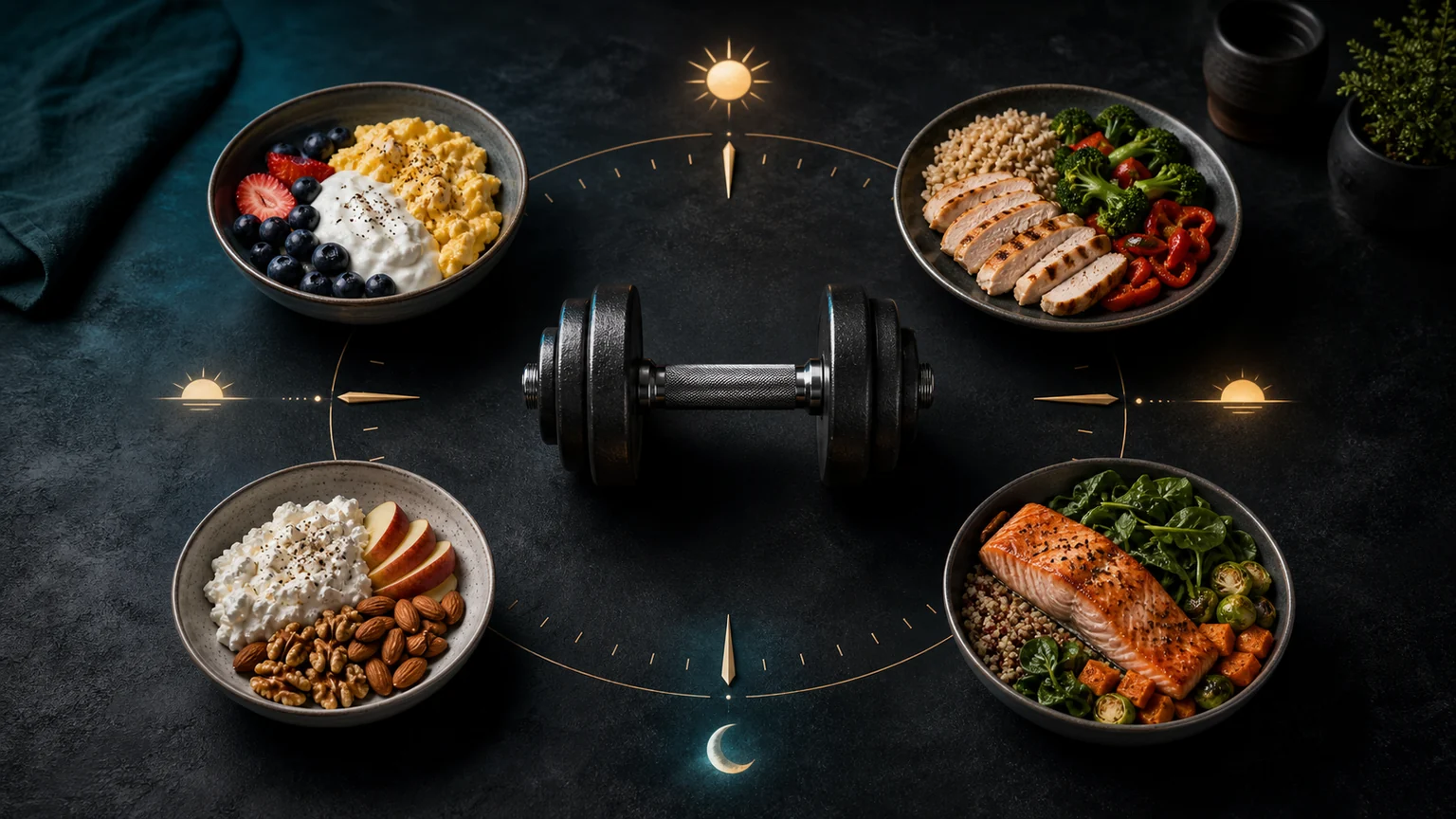
- Protein: use a daily plan you can repeat, then distribute it across meals instead of trying to rescue the day with one oversized serving.
- Recovery: sleep, life stress, training age, and starting body composition change how much dieting stress a person can tolerate.
A six-step setup for a lifter's cut
- Record a baseline. For about two weeks, record morning body weight under similar conditions, normal food intake, waist measurement, and performance on two or three anchor lifts. Day-to-day scale changes are noisy; use an average rather than reacting to one reading.
- Make one modest food change. Reduce a repeatable portion, snack, drink, or meal component. Do not simultaneously add a large amount of cardio and slash food.
- Plan protein by meals. The ISSN position stand describes roughly 1.4–2.0 grams per kilogram per day as sufficient for most healthy exercising adults and notes that higher intake may help some resistance-trained people during calorie restriction. That is evidence context, not an individual prescription. Kidney disease, pregnancy, digestive conditions, and eating-disorder history require qualified guidance.
- Keep anchor lifts recognizable. Retain a squat or leg-press pattern, a hinge, a press, and a pull in forms you can perform consistently. Keep technique and useful effort; you do not need frequent maximal attempts.
- Trim low-priority volume first. If recovery worsens, remove a set from accessory work or reduce conditioning before abandoning the main resistance-training signal.
- Use a scheduled decision point. Hold the starting plan long enough to see a trend, commonly two or three weeks, unless symptoms or a rapid decline require an earlier change.
Worked example: an 80 kg recreational lifter
Consider an 80 kg lifter whose weight has been stable and who trains three days per week. This is an illustration, not a calorie prescription.
- The lifter keeps three anchor records: squat variation for 3 sets of 6, dumbbell press for 3 sets of 8, and row for 3 sets of 10.
- Using 1.6–2.0 grams per kilogram as a planning example produces 128–160 grams of protein per day. Four meals containing about 35 grams each would total 140 grams. Food preference and medical context can justify a different plan.
- One repeatable food portion is reduced while training frequency stays the same. Extra cardio is not added during the first two weeks.
- The weekly averages move from 80.0 kg to 79.6 kg and then 79.2 kg. The anchor lifts remain within the normal rep range, sleep is acceptable, and daily function is unchanged, so the lifter keeps the plan rather than cutting more food.
If body weight begins falling much faster while several anchor lifts, sleep, mood, and concentration decline, the right response is not automatically to push harder. The lifter can restore some food, reduce low-priority training volume, or pause the cut long enough to identify which stressor changed.
How to train while calories are lower
- Keep useful intensity: use loads heavy enough to require effort while leaving one to three clean reps in reserve for most working sets.
- Earn progression: add a rep only when the previous session's range, control, and recovery were acceptable. Add a small amount of load after the top of the rep range is repeatable.
- Expect some variability: one weak session does not prove muscle loss. Look for a pattern across several sessions and exercises.
- Reduce volume before quality: two productive sets can be more useful than four deteriorating sets when recovery is limited.
- Keep cardio compatible: use a dose and mode that do not repeatedly disrupt leg training or ordinary recovery.
A weekly keep, adjust, or pause decision
- Keep the plan: the weight trend is gradual, anchor lifts are broadly stable, hunger is manageable, and sleep and daily function remain acceptable.
- Adjust one variable: there is no trend across several weeks and adherence is consistent. Change one food portion or activity target, then observe the new trend.
- Reduce training stress: soreness, poor sleep, and declining performance are accumulating. Remove low-priority sets, conditioning, or failure work before changing every exercise.
- Get emergency care now: stop exercising and call your local emergency number for chest pain, fainting, severe shortness of breath, confusion, a seizure, or repeated vomiting with inability to keep fluids down. Dark or cola-colored urine after hard exercise—especially with severe muscle pain, swelling, or weakness—also needs urgent medical assessment.
- Arrange timely professional follow-up: persistent dizziness, rapid unexplained weight loss, missed menstrual cycles, worsening obsessive food or exercise behavior, or inability to manage ordinary daily activity needs a clinician or registered dietitian rather than another diet adjustment.
Common mistakes
- Using each workout as a calorie-burning contest instead of preserving a repeatable strength stimulus.
- Changing food, cardio, lifting volume, and exercise selection at the same time.
- Interpreting a short-term drop in scale weight as pure fat loss or one poor workout as proof of muscle loss.
- Removing carbohydrates from training meals even when that makes hard sessions less productive.
- Trying to preserve every set from a gaining phase while food and recovery are lower.
- Ignoring dizziness, menstrual changes, sleep disruption, or disordered-eating warning signs because the scale is moving.
What the evidence can and cannot tell you
The athlete study comparing slower and faster weight loss supports a gradual approach in that population, but it does not establish one ideal weekly rate for every lifter. A controlled trial found better lean-mass outcomes with higher protein during a marked energy deficit and intense training, but that short intervention does not mean every reader needs its exact diet or exercise dose. Body-composition devices and scale estimates also have error, so combine measurements with training and recovery trends.
Sources: ISSN protein and exercise position stand; Garthe and colleagues on two weight-loss rates in athletes; Longland and colleagues on protein during a marked energy deficit; and NIDDK guidance on choosing a weight-loss program.
Continue with the per-meal protein guide, the training-log framework, the sleep decision guide, and RPE examples.